When your doctor has given you restrictions
, 4 min read
After a holiday, or after months when the routine fell apart, most people come back to the gym. I wrote about that kind of comeback in another article.
This article is about a comeback that starts somewhere else: after an injury, after surgery or with a diagnosis that hasn't gone away.
With that kind of comeback, my first concern is that you don't hurt yourself. The strength you have lost can be made up later.
A limit from your doctor isn't negotiated or tested
 Training well below the doctor’s limit, enlarge
If you have been told not to lift more than twenty kilos, it isn't my job to find out whether it might work anyway. It's a boundary we work with as a given.
And above all: the plan is built so there's no reason to even get close to that boundary. Exercises for the deep stabilising system, mobility and technique are done with bodyweight or a few kilos. A whole training session fits between nothing and twenty kilos.
You don't need a paper for it. It's enough that you remember what your doctor told you. Write it to me in your own words. It's less precise than a report, but it's still information a plan can be built on.
What I need to know beforehand
Some things don't rule out training, but they change it. High or low blood pressure, dizziness, recent surgery, medication that affects your heart rate. They aren't obstacles, they're information that decides which exercises we choose.
With high blood pressure, we leave out holding your breath and head-down positions. With low blood pressure, I watch out for getting up quickly from the floor. Finding that out in the middle of a session is too late.
In the same way, I need to know what hurt in the past and what hurts now. It's a difference that changes the whole training, and people don't mention it on their own. Why I send people for an examination even when nothing hurts is in my article Why I send you to a physio even when nothing hurts.
When to see a doctor first
 When to see a doctor first, enlarge
Most people come back after a break without any problems. But it's worth paying attention when:
- Your tiredness is out of proportion to the load and doesn't improve even after weeks
- Your weight has changed noticeably without you changing anything
- You feel pain that has nothing to do with muscle soreness, especially in a joint, or pain that doesn't stop even at rest
- The break was caused by an injury or illness and you haven't had a check-up since
In that case, seeing a doctor before going back to exercise makes more sense than improvising.
Why we fill in a health questionnaire together
Everyone who starts training with me fills in a short health questionnaire. In it I ask what hurts now and what hurt before, about injuries, surgery and medication, about blood pressure or dizziness, and about what your doctor or physiotherapist told you.
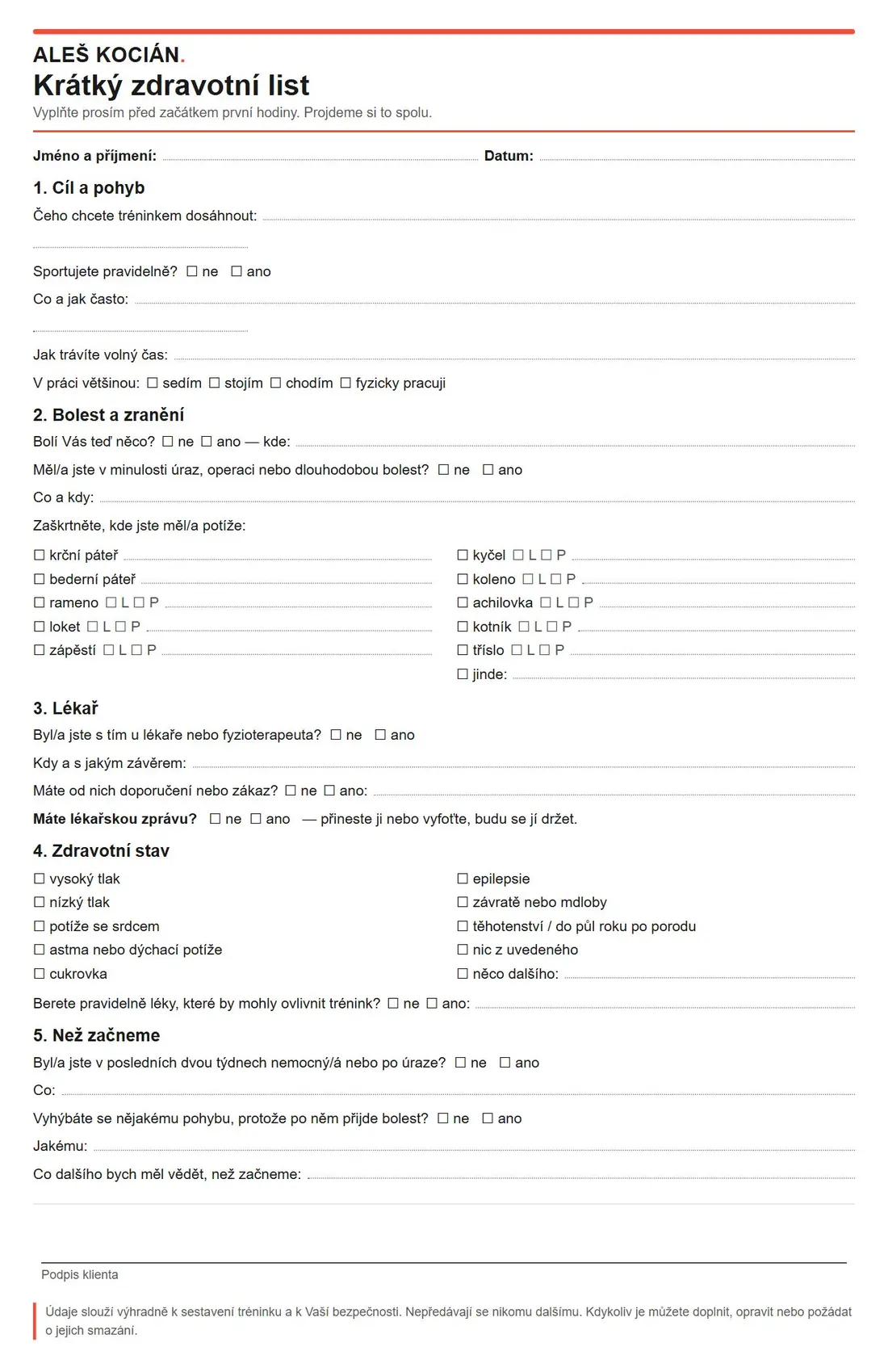 Sample of a blank health questionnaire, enlarge
I would ask about most of it at the first session anyway. But I have the questionnaire at hand every time I write your plan, and nothing from it gets lost, even when we're in a hurry at a session.
You can fill it in on paper at the first session, or beforehand in the portal. The information is used only to plan your training and for your safety. I don't pass it on to anyone, and you can add to it, correct it or have it deleted at any time.
Why we fill it in again after six months
More changes in six months than you would expect. A new medication comes along, an old pain fades and a different one appears, someone has surgery in the meantime. A year-old questionnaire describes a person who no longer comes to my sessions.
That's why the portal asks you for a new one after six months. If surgery, a serious injury or an illness comes along in the meantime, write to me straight away, don't wait six months.
What this means for the first session
That's why we don't start exercising straight away at the first session. First we go through the questionnaire together, what your doctor told you, what you're afraid of and when you feel the pain. Only then do I choose what we'll train that day.
It's a slower start than most people expect. Without it, though, I would be building the plan on guesswork.
This article describes general principles, not individual recommendations. If you have a specific diagnosis or restrictions from your doctor, discuss getting back to exercise with them too.
Sources: European Society of Cardiology, guidelines on sports cardiology, Pelliccia et al. (2021), European Heart Journal. Pescatello et al. (2004), Medicine & Science in Sports & Exercise. Riebe et al. (2015), Medicine & Science in Sports & Exercise. Warburton, Jamnik, Bredin, Gledhill (2011), PAR-Q+ questionnaire, Health & Fitness Journal of Canada.
Did you like the article?
Thank you for rating.
Rating is anonymous, I don't store anything about you.
Comments
Coming back after an injury or with restrictions from your doctor?
Write to me what your doctor told you and when it hurts. At the first session we'll go through the questionnaire together and I'll choose what we train that day.
I don't test a limit from your doctor. I build the plan so there's no reason to even get close to it.